Your Big Toe Controls More of Your Body Than You Think
The big toe is responsible for roughly 40–60% of your push-off force when you walk.
Every step. Every stride. Every time you climb a stair, stand up from a chair, or change direction.
Most men have spent decades cramping that toe into a narrow shoe. And then they wonder why their knee hurts.
What the Big Toe Actually Does
The technical term is "hallux" — and hallux function is one of the most underappreciated factors in lower body mechanics.
When you walk or run, the sequence goes roughly like this: heel strikes, weight shifts forward through the arch, and then the big toe extends (bends upward) as you push off. That extension is called the "windlass mechanism" — it tightens the plantar fascia and creates a stiff, propulsive lever that drives you forward.
When the big toe can't extend properly — because of stiffness, pain, or structural deviation — the body compensates. It always compensates. That's what bodies do.
The compensation usually looks like one or more of these:
- Pronation. The arch collapses inward to allow forward movement without the toe extending. This changes how force travels up the leg.
- External rotation. The foot flares out. The knee follows. Over time, this changes how the knee tracks.
- Shortened stride. Men reduce how much push-off they need by shortening the step. Less efficient, more fatigue.
Every one of these adaptations is invisible in the short term and noisy in the long term.
Try This Now
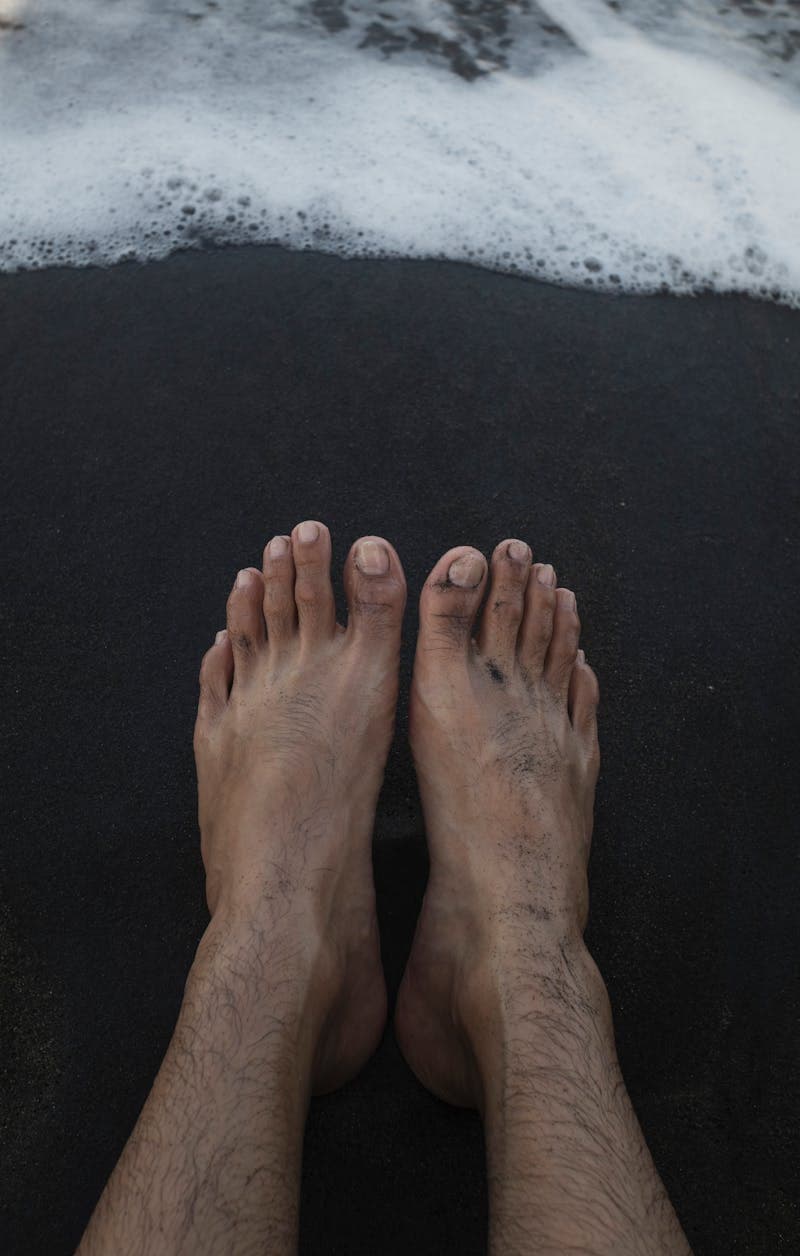
Stand barefoot on a hard floor.
Without moving your other toes, try to lift just your big toe off the ground. Hold it up, then lower it.
Now try the opposite: press your big toe into the floor while lifting your other four toes.
If either of these is difficult — if the toes move together, or you feel cramping, or you can barely isolate the movement — your intrinsic foot muscles have weakened from years of passive, supported footwear. This is common. Most men over 40 can't do this cleanly on the first try.
This isn't a party trick. It's a diagnostic.
Toe isolation is a proxy for foot muscle function. Feet with weak intrinsic muscles don't stabilize well, don't push off efficiently, and don't give the ankle, knee, and hip the base they need.

What Restricted Big Toe Mobility Looks Like Over Time
Hallux rigidus is the clinical term for a stiff, arthritic big toe joint. It's more common than most people realize, and it often develops after years of restricted movement and footwear compression.
Early signs include:
- Stiffness in the big toe after long periods of rest
- Aching at the base of the toe, especially with activity
- Difficulty with exercises that require toe extension (think: the top of a squat, running, climbing)
Later, the joint can lose significant range of motion — limiting not just foot function but the mechanics of everything above it.
The earlier this is addressed, the more options exist.
What You Can Do About It
Stretch for extension — daily
Sit and pull your big toe gently back toward your shin. Hold for 30 seconds. Repeat. Do this after your shower while the tissue is warm.
It's not glamorous. Thirty seconds a day compounds over time.
Separate your toes
Years of narrow shoes teach toes to live close together. Toe spacers — worn for short periods while barefoot at home — gradually remind the toe where it's supposed to sit. Some men notice improved balance and reduced forefoot ache within a few weeks.
Build the intrinsic muscles
The toe isolation drill above isn't just a test — it's also the exercise. Practice it. Set a timer for two minutes and work through: big toe up, big toe down, all toes up, big toe down while others stay up. Progress is slow and uneven at first. Keep going.
Be strategic about footwear
Look for shoes with a wide toe box — enough that your toes can spread naturally when bearing weight. This matters more than arch support for most men. A foot that can spread and grip is a more stable, more functional foot.
The Compounding Problem
The big toe, like most things related to foot health, is a compounding issue.
A slightly stiff toe changes your gait. Changed gait changes how load moves through the knee. Changed knee mechanics change how the hip compensates. By the time a man in his late 40s develops chronic knee pain, the chain of cause and effect may trace back to a big toe that lost its range of motion in his 30s.
This isn't fatalism — it's useful information. The chain works in both directions. Restoring big toe mobility and strength improves the mechanics of everything above it. Not overnight, but consistently.
Bottom Line
The big toe isn't a footnote in your body's mechanics. It's one of the primary levers in how you walk, run, push, and stabilize.
If yours has been compressed, restricted, or ignored — which is most men's experience — the work to address it is simple, consistent, and starts barefoot in your living room.
That's usually how it goes with feet.