Knee Pain That Starts in the Feet: The Pronation Chain
Your knee hurts. You've been to the orthopedist. Imaging shows nothing dramatic. You've done the standard knee exercises. It still hurts.
If you're a man over 40 with knee pain that hasn't resolved with knee-specific treatment, there's a decent chance the mechanism starts one joint lower. Overpronation (excessive inward roll of the foot during walking or running) rotates the shin internally, which pulls the kneecap off its normal groove. The pain shows up at the knee; the cause sits at the foot.
This piece covers the pronation chain, the self-check that tells you whether this is your pattern, the shoe + insole + strengthening fix, and when to see an orthopedist versus a podiatrist.
If you're not sure where your knee pain is coming from, the 5-minute self-check covers a broader diagnostic.
What overpronation is
Some pronation is normal and useful: the foot's inward roll during walking or running is how the arch absorbs shock and stores elastic energy for push-off. Anatomically, it's the subtalar joint moving through eversion combined with the mid-foot flattening slightly.
Overpronation is when that roll goes too far. The arch flattens more than it should, the heel tips outward, and the shin rotates internally to follow. Because the femur (thigh bone) is anchored at the hip, it doesn't rotate as much as the shin does; the mismatch happens at the knee. The kneecap is pulled off its groove in the femur, which is the mechanical cause of most patellofemoral pain syndrome (runner's knee).
Overpronation gets worse after 40 for three reasons:
The intrinsic foot muscles that hold the arch are weaker (decades of supportive shoes).
The posterior tibial tendon, which is the main dynamic arch support, weakens gradually and in some men progresses to full dysfunction.
Body weight typically increases, and the arch structure now supports more load with less muscular backup.
The pronation chain (foot → knee)
The kinetic chain runs upward, joint by joint:
- Foot pronates: arch flattens, heel tips outward.
- Shin (tibia) rotates internally: the tibia follows the foot into internal rotation.
- Knee tracking shifts: the kneecap (patella) is pulled laterally, off its normal groove in the femur. Cartilage on the underside of the patella wears against the femoral groove.
- Femur adducts and internally rotates: if the hip abductors are weak, the femur follows.
- Pelvis drops on the opposite side: the hip abductors don't stabilize the pelvis under single-leg load.
- Compensation goes up: lower back, sometimes shoulder.
Knee pain is often the loudest complaint because the knee has the least tissue redundancy. Fix the foot mechanics; the chain resolves upward.
The self-check
Two tests, no equipment beyond a mirror.
The single-leg squat mirror test. Stand in front of a full-length mirror. Lift one foot slightly off the floor. Slowly lower yourself into a quarter squat on the standing leg. Watch the knee.
- Knee stays over the middle of the foot: normal alignment. Your knee pain is likely not pronation-driven.
- Knee drifts inward, past the big toe: classic pronation chain. The arch is collapsing under load, rotating the shin, and pulling the knee inward.
Do both sides. Asymmetry (one side much worse) is common.
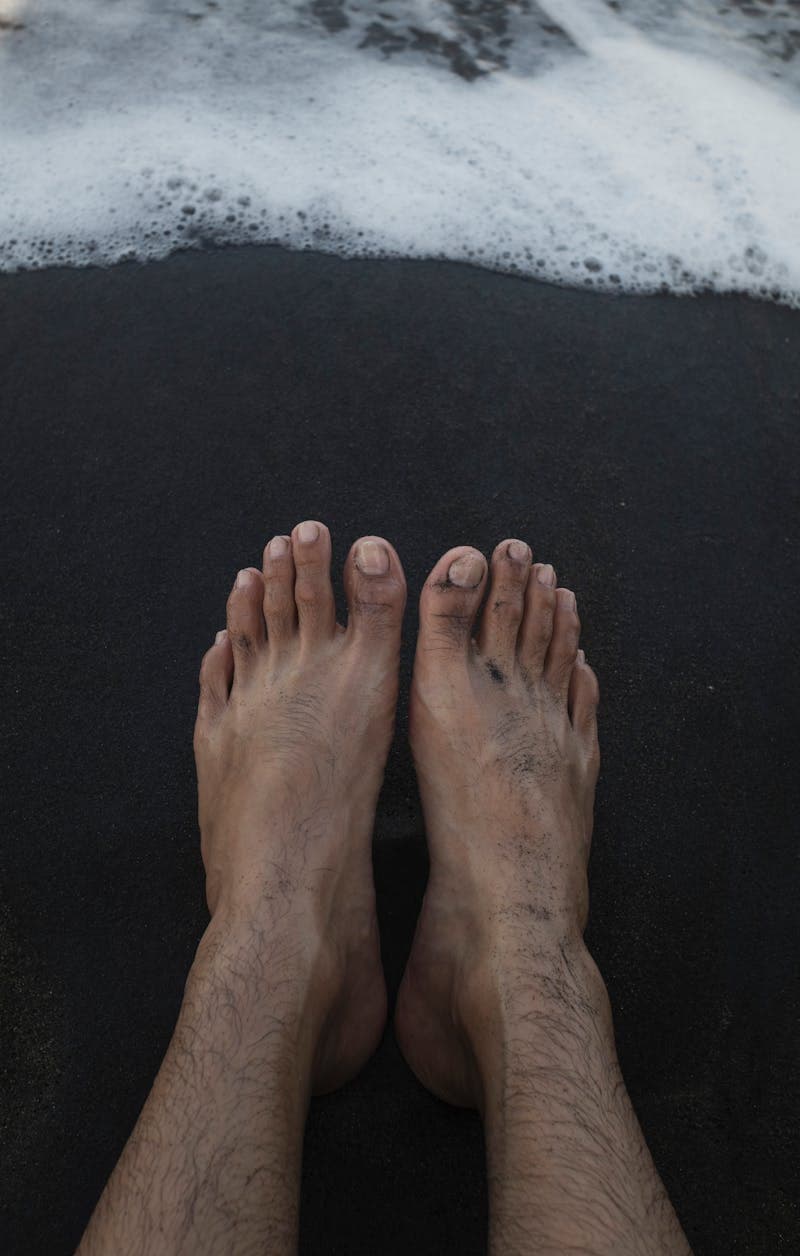
The wet-foot test. Wet the soles of your feet, step onto a dry piece of cardboard, and look at the imprint.
- Full-sole print with no arch cutout: flat feet. Overpronation is nearly certain.
- Deep arch cutout: high-arched. Overpronation is not your problem; supination (opposite pattern) is possible.
- Moderate cutout: neutral. Overpronation may still show up under load; use the squat test as the tiebreaker.
If the squat test shows knee cave AND the wet-foot test shows a flat or moderate arch, pronation chain is likely your mechanism.
The fix
Three levers, in this order of impact:
1. Supportive insoles (immediate)
For confirmed pronation-driven knee pain, an off-the-shelf supportive insole is the fastest intervention. Superfeet BLUE is our default recommendation: firm arch support that reduces arch collapse and stops the shin-rotation cascade.
Trial period: 4 weeks in your daily shoes. If knee pain drops by more than 50 percent in 4 weeks, the diagnosis is correct and the insole is doing its job. If nothing changes, the mechanism is probably something other than pronation.
Custom orthotics: consider only after 2 off-the-shelf brands (each with a 4-week trial) have failed. Custom adds cost ($300 to $600) without adding much benefit for the majority of pronation cases. Not first-line.
2. Wider-toe-box, stability shoes (within a month)
The insole works better in a shoe with:
- Wider toe box so the intrinsic foot muscles have room to engage.
- Firm medial post (the shoe has extra support along the inner edge). Shoes labeled "stability" or "motion control" have this built in.
- Adequate cushioning at the heel and forefoot.
Look for stability lines in Brooks (Adrenaline GTS), Asics (Kayano), New Balance (860). Avoid minimalist/barefoot shoes for confirmed pronators; they aggravate the pattern.
3. Strengthening (over months)
This is the long-term fix that reduces dependency on the insole. Two muscle groups matter:
Intrinsic foot muscles: run the foot strength routine three times a week. Short-foot activation, towel scrunches, single-leg balance work. These are the muscles that actively hold the arch under load; strong intrinsics reduce pronation depth.
Hip abductors: clamshells, side-planks, single-leg deadlifts. When the hip abductors are strong, the femur doesn't follow the shin into internal rotation, and the knee stays over the foot.
Both take 8 to 12 weeks to show meaningful strength changes. Insole gives you immediate relief while the strengthening works.
When to see a doctor
Podiatrist first if: pronation-driven knee pain hasn't improved with off-the-shelf insoles after 4 to 6 weeks. They'll assess whether custom orthotics or a formal PT referral is next.
Orthopedist if: knee pain is sharp (not aching), localized to a specific structure (medial vs lateral vs behind kneecap), or accompanied by swelling, catching, or giving-way. Imaging may be needed to rule out meniscus, ligament, or cartilage damage.
Physical therapist if: you've been shown to have pronation via the self-check AND you've tried insoles + strengthening on your own for 8 weeks with limited improvement. A PT can identify compensatory patterns above the knee that home strengthening might miss.
Bring the doctor-prep checklist so the visit stays focused.
What doesn't work (or works less than you'd think)
Knee braces. They compress the area, which feels supportive, but they don't address the mechanism. Fine for symptom management during a flare; not a fix.
Knee-only strengthening. Quad sets, knee extensions, and even squats often make patellofemoral pain worse if the underlying pronation isn't addressed first. The knee compensates for what's happening at the foot; strengthening the knee doesn't change what's happening at the foot.
Stretching the IT band aggressively. The IT band tightness is often a symptom of hip abductor weakness, not the cause of knee pain. Strengthening the hip resolves the tightness; foam-rolling the IT band alone doesn't.
Rest. Complete rest lets everything weaken. Reduce load; don't stop moving.
Bottom line
If your knee pain hasn't responded to knee-specific treatment and you have a positive single-leg squat mirror test, the mechanism is probably pronation. Insole + stability shoe + foot and hip strengthening resolves most cases in 6 to 12 weeks.
If pronation isn't your mechanism, the 5-minute self-check covers alternate diagnoses. If your knee pain has red-flag features (sharp, localized, swelling, giving-way), skip straight to an orthopedist.
For the broader alignment context on how foot mechanics travel up the chain, see why toe alignment affects your knees and hips.