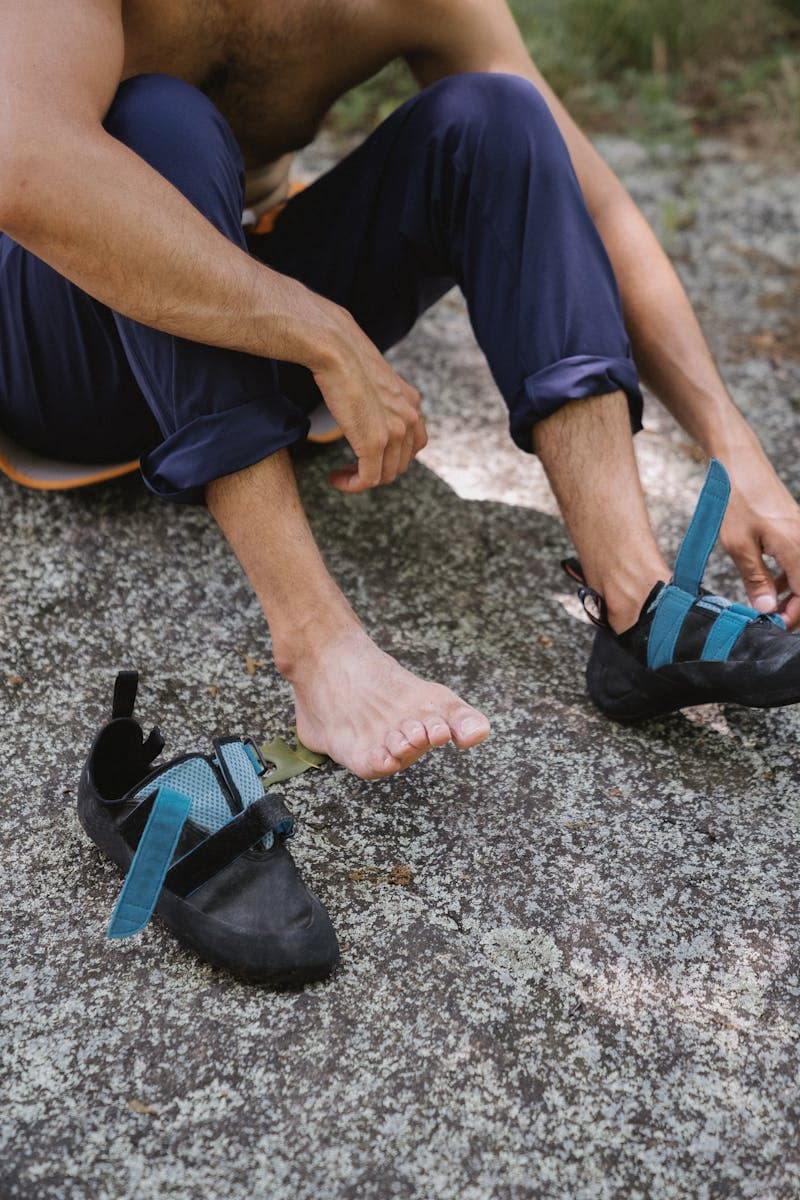

Post-Workout Foot Recovery: An 8-Minute Routine for Men Over 40
Eight minutes. Done within 30 minutes of finishing your run or lift. Three things: calf release, plantar fascia work, toe extension.
If you're training regularly at 40+, this is the routine that shrinks recovery from "48 hours until my feet stop aching" back to "overnight." Skipping it is what turns small session-to-session accumulation into a flare that sidelines you for two weeks.
Who this routine is for
- Men over 40 who run 3+ times a week.
- Men who lift with a lower-body component (squats, deadlifts, cleans).
- Men who play sports that involve running or cutting (basketball, soccer, tennis, pickleball).
- Men who do long walks or hikes as their primary movement.
Who this is NOT for
- Men who are already flaring (sharp plantar fasciitis, Achilles pain over 5 out of 10). Do the movement routine or recovery routine instead until pain drops below 3.
- Rest days. Do this on training days only.
Why post-workout foot care matters more at 40
Three shifts happen in the 40s that make skipped recovery expensive:
Tissue turnover slows. Collagen synthesis in tendons and fascia dropped 15 to 30 percent between your 20s and 40s. The same training load now produces micro-tears that take longer to close. Skipping the recovery layer lets small tears accumulate into a stress reaction within 2 to 3 weeks.
Fat pad thinning. The heel and forefoot fat pads have lost 15 to 30 percent of their thickness by 45. Post-workout impact concentrates on tissue that has less cushion; the immediate soreness is a signal, not a nuisance.
Sleep-based recovery is less generous. Deep sleep (where most tissue repair happens) reduces after 40. What used to bounce back overnight now needs mechanical help.
The 8-minute routine addresses all three by warming, releasing, and mobilizing while the tissue is still warm from load.
The Protocol
Three moves, in order. Do within 30 minutes of finishing training. About 8 minutes total.
1. Calf release (3 minutes)
Sit on the floor. Place a foam roller (or a lacrosse ball for more depth) under your calf. Cross the other leg on top for extra pressure. Roll slowly from the Achilles insertion up to the back of the knee.
90 seconds per side.
Where to pause: on any tender spot, hold static pressure for 20 to 30 seconds until the discomfort drops by half. Move on.
Common mistake: rolling fast. Fast rolling doesn't reset the muscle tone; slow rolling with pauses does.
2. Plantar fascia work (3 minutes)
Sit in a chair. Place a lacrosse or tennis ball under one foot's arch. Slowly roll from heel to ball of foot, using controlled body weight to add pressure.
90 seconds per side. Slow rolls, not fast passes.
Progression: once bodyweight rolling feels easy (usually after 2 weeks), stand up and shift more weight onto the ball. More pressure = deeper release.
When to skip: during a plantar fasciitis flare with sharp first-steps pain over 3 out of 10. Rolling angry tissue extends the flare.
3. Toe extension work (2 minutes)
Sit with one foot in your lap. Grip the toes and gently pull them upward (extension) as far as they comfortably go. Hold 30 seconds. Release. Repeat.
Do 2 holds per side.
Why it works: running and lifting compress the toes together and shorten the toe extensors. Passive toe extension counters that compression and maintains the big-toe range that most men lose progressively in their 40s.
Bonus: while you have the foot in your lap, spend the last 30 seconds pressing your thumb along the plantar fascia from heel to ball. Feel for tight spots.
Weekly progression
Week 1 to 2. Do the routine after every training session, in order. Expect the calf and fascia release to be uncomfortable; that's the point.
Week 3 to 4. Add load on the calf release (foam roller → lacrosse ball). Start noticing which tender spots are consistent; those are your compensation patterns.
Week 5 and beyond. Maintenance. Some men keep the full 8-minute routine; others compress to a 4-minute version (skip the toe extension) on shorter training days. The calf release is the piece to keep no matter what.
Rest day option: the routine works on rest days too, but with lower priority. If you skip on rest days, do the morning stretch routine instead to keep the tissue at working length.
What to skip (and common mistakes)
Icing routinely after every run. Ice reduces the adaptation signal you want for the next training block. Save ice for actual sharp-pain flares (5 to 10 minutes, once), not general soreness. General soreness is the training working.
Skipping the calf work because your feet are what hurt. The calf is the upstream cause of most over-40 runner foot pain (plantar fasciitis, Achilles tendinopathy, morning heel pain). Skipping the calf release to focus on the foot is treating the symptom.
Rolling the tendon itself. The Achilles tendon does not respond well to direct rolling; the calf muscle above it does. Roll the calf, leave the tendon alone.
Doing this instead of a proper warm-up before the next session. Post-workout recovery is not pre-workout preparation. The morning stretch routine is your pre-training work.
Skipping because you feel fine. The point is prevention. If you feel fine now and you skip, you feel less fine three weeks from now.
What to add outside the routine
- Sleep. Adequate deep sleep is where most tendon repair happens. Runners over 40 who consistently get under 7 hours have measurably higher chronic foot pain rates.
- Protein. 1.6 to 2.0 grams per kg of bodyweight per day supports connective tissue repair. Under 1.4 g/kg starts showing up as slower recovery.
- Rotate shoes. Two pairs alternated across the week gives each pair time to decompress. Foam recovers between sessions; not rotating accelerates shoe wear and changes the load pattern.
When to see a podiatrist
Most post-training foot soreness responds to the 8-minute routine. Some cases don't:
- Sharp pain during training that lingers into the next day: reduce mileage by 30 to 50 percent for 2 weeks; if still sharp, see a sports podiatrist.
- Pain in one specific spot that gets worse each session: possible stress fracture, needs imaging.
- Nighttime pain that wakes you up: not routine soreness; escalate.
- Any change in foot pain with diabetes: escalate.
Bring the doctor-prep checklist so the visit stays focused.
Bottom line
Eight minutes within 30 minutes of finishing training. Calf release, plantar fascia work, toe extension. Every training day.
If you're a runner over 40, this is the single highest-leverage habit for staying in the sport into your 50s. If you're a lifter or a weekend athlete, same protocol, same effect.
For the "why is my foot suddenly hurting to run at 45" backstory, see runners over 40 foot pain. For the specific tendinopathy protocol, see Achilles tendon pain. If you're not sure which pattern is yours, run the 5-minute self-check.